
What to Look for When Buying a Cold Plunge in 2026 for Small Spaces
A cold plunge built for a small space should hold at least 45 to 65 gallons, cool water down to a steady 39 to 55 degrees Fahrenheit with a standalone chiller rather than bagged ice, and fit inside roughly a 3 to 4 foot footprint with clearance on at least one side for service access. Expect to spend $2,500 to $9,000 for a compact unit with filtration included, plus $300 to $800 for a dedicated electrical circuit if one is not already in place. The chiller quality, tank material, and filtration loop matter more than the badge on the side once those basics are covered.
How Much Floor Space Does a Cold Plunge Actually Need?
Single-person tubs built for apartments, condos, and tight patios generally measure 30 to 40 inches in diameter and stand about 30 inches tall, which puts the footprint in the same range as a large recycling bin. Add another 12 to 18 inches of clearance on the side where the chiller sits so filters and hoses stay reachable. A corner of a garage, a covered section of a balcony rated for the weight, or a spot next to an existing outdoor shower all work. What does not work is a footprint that leaves no access to the drain plug or the chiller intake, because that turns routine maintenance into a two-person job every time.
Chiller or Ice: Which Cooling Method Makes Sense for a Small Setup?
Ice-only tubs are cheaper up front, often under $1,000, but they need 40 to 80 pounds of ice per refill and the temperature drifts upward within a couple of hours. For anyone plunging more than once or twice a week, a small space usually calls for a standalone chiller instead. A 1/2 to 1 horsepower chiller can hold 45 to 65 gallons at a target temperature indefinitely, draws roughly as much power as a window air conditioner, and removes the ongoing cost and hassle of buying ice. The tradeoff is the chiller itself needs airflow, so it cannot be boxed in tightly on all sides.
What Tank Material Holds Up in a Compact Install?
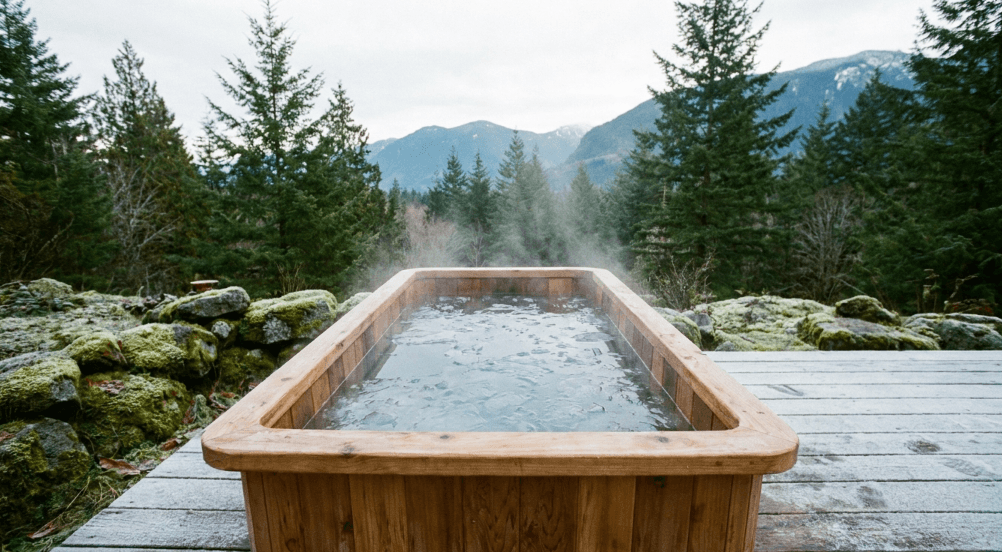
Rotomolded plastic and fiberglass-reinforced acrylic are the two materials that show up most often in home-sized plunges, and both hold up fine outdoors if the tank is rated for it. Stainless steel tanks look sharp and resist algae growth well, but they conduct heat faster, meaning a chiller has to work harder in direct summer sun without some kind of cover or shade. Wood-clad tanks, often cedar or heat-treated hemlock over a plastic liner, insulate better and fit a small backyard’s aesthetic, though they need occasional resealing where the wood meets the water line.
How Many Gallons Is Enough for One or Two People?
For solo use, 45 to 65 gallons is the sweet spot: enough thermal mass that the chiller is not constantly cycling, without wasting water or power on volume nobody uses. A household planning to share the plunge between two adults, even if not at the same time, should look closer to 80 to 110 gallons so water quality and temperature stay consistent between back-to-back sessions. Anything larger starts pushing into spool or small-pool territory, which is a different category of install with its own foundation and electrical requirements.
What Should a Buyer Budget for in 2026?
Compact chiller-equipped tubs run $2,500 to $6,000 for the unit alone, with premium stainless or wood-clad models reaching $9,000 to $12,000. Add filtration cartridges or a sand filter setup ($150 to $400), a cover ($100 to $300), and electrical work if a new circuit is needed. Buyers comparing options across brands often start with the SweatDecks catalog to see current sizing and pricing side by side before narrowing down to a specific chiller horsepower and tank material. From there, matching the unit to the actual footprint available at home is the step that prevents a return or a reseller listing six months later.
What Filtration Keeps a Small Tank Sanitary?
A cartridge or sand filter paired with an ozone generator is the most common setup for home units, cycling water through the loop for a few hours a day to control bacteria without relying on heavy chlorine dosing. UV sanitizers are a common add-on in higher-end models and work well alongside ozone. Whatever the system, plan on replacing cartridges every one to three months depending on use frequency and shocking the water occasionally, especially in a small tank where the same gallons get reused for weeks at a time.
How Long Does a Compact Unit Typically Last?
A well-built compact plunge with a reputable chiller can run eight to twelve years before the compressor needs replacing, provided the intake screen stays clean and the unit is not run dry. Warranty coverage varies a lot across manufacturers: some cover the chiller compressor for two to five years while covering the tank shell for a decade or more, and others bundle everything under one shorter term. Reading the warranty terms before buying, specifically what counts as normal wear versus a covered defect, saves a headache down the line. It is also worth asking whether local service technicians handle the specific chiller brand, since a compressor issue on a model with no regional support can mean shipping the whole unit back to the manufacturer, which turns a repair into weeks of downtime. None of this shows up next to the gallon capacity on a spec sheet, but it matters just as much for a small-space buyer with no room for a backup unit while the primary one sits in for repair.
What Noise Level Should a Buyer Expect?
Most home chillers run in the 45 to 55 decibel range while cycling, roughly comparable to a running refrigerator or a window air conditioner on a low setting. That is quiet enough for a garage or covered patio but worth checking against the specific model’s spec sheet if the plunge will sit close to a bedroom window or a shared wall in a duplex or apartment building. A handful of premium chillers advertise noticeably quieter operation, closer to 40 decibels, which costs more but can matter a great deal in a genuinely tight living situation where the unit runs for hours at a stretch.
Frequently Asked Questions
Do I need a chiller or can I just use ice?
Ice works for occasional use but a standalone chiller is what makes daily use practical in a small space. A chiller holds a set temperature automatically and pairs with a filtration loop so the tank stays sanitary between sessions.
How small can a cold plunge tank be and still work?
Compact tubs built for one person typically hold 45 to 65 gallons in a footprint close to 3 by 3 feet, which is enough volume for a chiller to hold a steady temperature through repeated short sessions.
What amperage does a cold plunge chiller need?
Most residential chillers run on a dedicated 20-amp circuit at 120V or 240V depending on the model. Checking the manufacturer’s electrical spec sheet before scheduling an electrician avoids a second visit.
Does a cold plunge need a floor drain?
It is not required, since most tanks drain through a hose to a yard or utility sink, but a floor drain nearby makes water changes and filter maintenance easier for an indoor install.
References
- Effects of cold-water immersion on health and wellbeing: A systematic review and meta-analysis, PLoS One, 2025
- Effects of cold water immersion after exercise on fatigue recovery and exercise performance: meta analysis, Frontiers in Physiology, 2023
- Cold-water immersion (cryotherapy) for preventing and treating muscle soreness after exercise, Cochrane Database of Systematic Reviews, 2012


